
25 Sept 2026 · Gurjot Singh Sidhhu
Coaching Institute Management Software for Small Businesses
Discover how coaching institute management software can help F&B brands manage product training, retailer onboarding, workshops, payments, CRM and follow-ups.
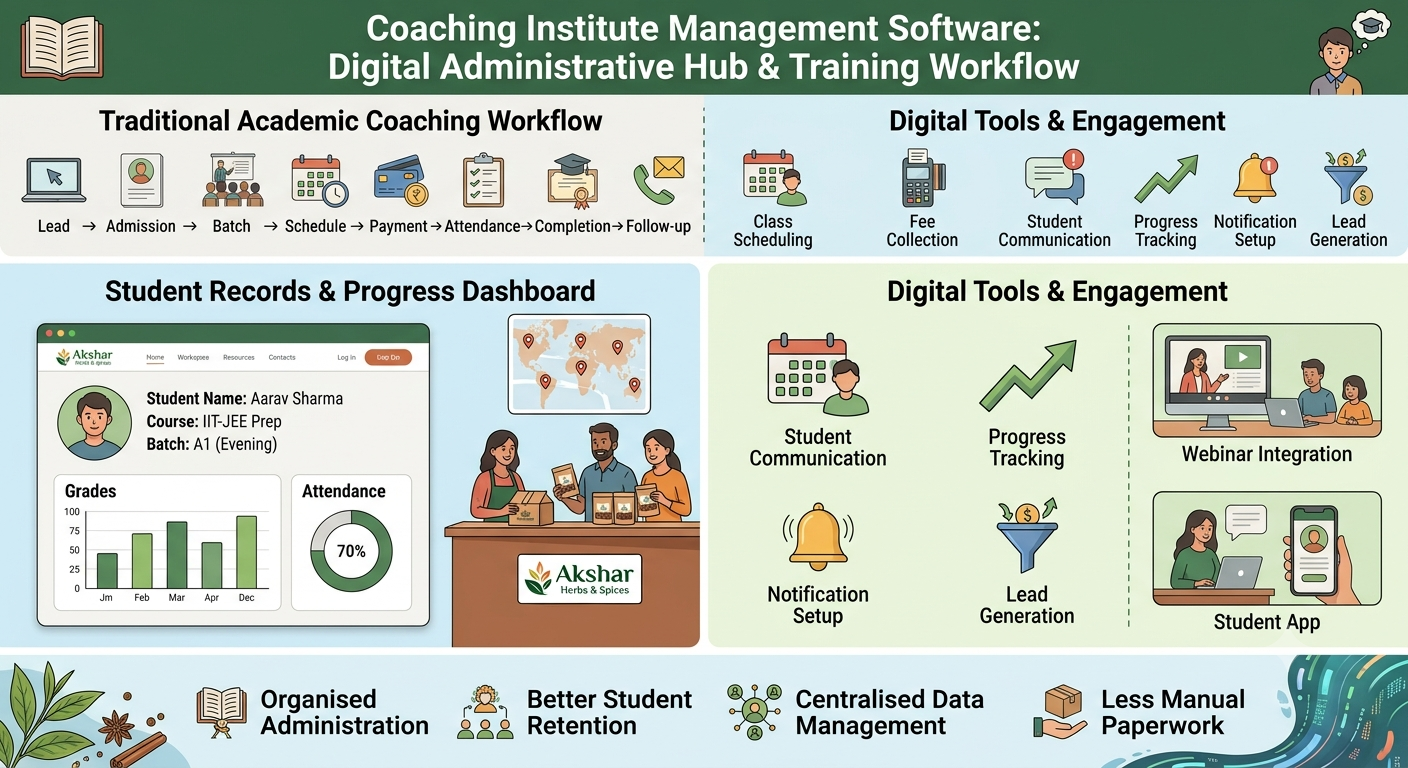
Small businesses are increasingly looking beyond traditional advertising to educate customers, train retailers, build wholesale relationships, and create stronger product experiences. For tea, wellness, specialty food, and other product-based brands, workshops and training programmes can become an important part of customer and retailer engagement.
However, running these programmes manually can quickly become complicated. Businesses may need to manage registrations, batches, schedules, payments, participant records, reminders, follow-ups, and sales opportunities at the same time.
This is where coaching institute management software can offer an interesting solution.
Although this type of software is traditionally designed for coaching centres and educational institutes, many of its core workflows are not limited to education. Registration, batch scheduling, payment collection, CRM, attendance, communication, and follow-up can also support product training, retailer onboarding, workshops, and customer education.
For example, a tea brand could use the same system to organise tea-tasting workshops, train retailers, sell sample packs, collect payments, and track whether participating retailers are interested in placing wholesale orders.
What Is Coaching Institute Management Software?
Coaching institute management software is a digital platform designed to help educational and training organisations manage their daily operations from a central system.
Instead of maintaining separate spreadsheets, notebooks, payment records, contact lists, and messaging tools, an institute can use one platform to manage its learners and administrative workflows.
Typical modules include:
Student or participant registration Admission management Batch management Class scheduling Attendance tracking Fee and payment management Customer or student records CRM and lead management Automated notifications Reports and dashboards
The important point for small businesses is that these features represent a workflow, not just an education-specific process.
A coaching centre might manage:
Lead → Admission → Batch → Schedule → Payment → Attendance → Completion → Follow-up
A tea brand could adapt the same workflow:
Retailer Lead → Workshop Registration → Training Batch → Product Training → Sample Purchase → Wholesale Follow-up → First Order → Reorder
That makes coaching software potentially useful as a form of training management software for businesses.
Why Can Small Businesses Repurpose Coaching Software?
Small businesses often do not need a completely different technology stack for every activity.
A specialty food company, for example, may need to organise a retailer training programme. The company needs to know who registered, which batch they belong to, whether they paid, whether they attended, what products they are interested in, and when someone should follow up.
Those are very similar administrative requirements to running a coaching programme.
Common coaching features and business applications Coaching software feature Small-business application Admissions Workshop registration Batch management Retailer training batches Class scheduling Product demonstrations Student profiles Retailer/customer profiles Fee management Workshop payments Attendance Training completion CRM Wholesale lead management Notifications Workshop reminders Reports Training and sales tracking Follow-ups Wholesale and reorder communication
This is why coaching institute software can be repurposed as a practical operational system for certain small businesses.
It does not replace specialised manufacturing, inventory, or accounting software. Instead, it can handle the people, training, registration, communication, and sales-follow-up side of the business.
How Akshar Herbs & Spices Could Use the System
Consider Akshar Herbs & Spices as a hypothetical example.
Suppose the brand wants to develop educational programmes around tea, herbs, spices, preparation methods, product knowledge, and retail selling.
Instead of simply promoting products, the brand could create structured educational experiences for consumers and retailers.
For example, it could offer:
Tea-tasting workshops Retailer product-training sessions Wholesale partner orientation Tea preparation workshops Product knowledge sessions Specialty tea discovery sessions Sample-pack experiences
A coaching-style management platform could provide the administrative infrastructure behind these programmes.
A possible retailer journey
A retailer discovers an upcoming training programme and submits a registration form.
The system creates the retailer's profile and records the lead.
The retailer selects a training batch and makes the required payment.
The system automatically sends a confirmation.
Before the session, an automated reminder is sent.
After attending the programme, the retailer's profile can be updated with:
Products discussed Sample packs purchased Wholesale interest Preferred product categories Follow-up date Potential reorder date
The sales team can then use the CRM to continue the conversation.
This creates a connection between education and commerce without forcing the business to manage every step manually.
Product Training Programs Made Easier
Product knowledge becomes particularly important when a brand sells through retailers.
A retailer may need to understand:
What the product is How it is prepared Who the target customer is What makes it different How to explain it to customers Which products complement each other How to recommend different variants
Instead of giving retailers a document and expecting them to learn independently, a brand could create structured training batches.
For example:
Batch 1: Introduction to Specialty Tea
Duration: 60 minutes Audience: New retailers Format: Online or in-person
Topics:
Introduction to the product range Understanding tea varieties Brewing basics Product positioning Customer recommendations Frequently asked questions Batch 2: Retail Product Knowledge
Duration: 90 minutes Audience: Existing retail partners
Topics:
Product portfolio Customer preferences Product demonstrations Cross-selling opportunities Sample usage Wholesale ordering process
With batch management software, the business can organise participants into appropriate groups rather than coordinating every session manually.
Retailer & Wholesale Onboarding
Retailer onboarding is another area where coaching-style workflows can be useful.
A business can create a structured onboarding process instead of treating every new retailer as a separate conversation.
For example:
Step 1: Lead Captured
Retailer submits an enquiry.
Step 2: Qualification
The sales team records information such as:
Business type Location Product categories Current brands sold Estimated interest Contact details
Step 3: Training Invitation
The retailer receives an invitation to an upcoming training session.
Step 4: Registration
The retailer selects a batch or onboarding session.
Step 5: Training
The retailer attends the product-training programme.
Step 6: Sample Experience
The retailer receives or purchases a sample pack.
Step 7: Follow-Up
The sales team contacts the retailer after training.
Step 8: Wholesale Conversion
If the retailer is interested, the lead moves into the wholesale sales process.
This is where retailer onboarding software and CRM functionality can work together.
Combine Training With Product Sales
One of the most useful possibilities is combining education with product purchasing.
For example, a tea brand could create a workshop registration page where customers can select:
Workshop Only — ₹499
Includes:
60-minute tea-tasting workshop Guided tasting session Brewing guide
Workshop + Sample Pack — ₹799
Includes:
Workshop Selected tea samples Brewing guide Product information
Retailer Starter Experience — ₹1,499
Includes:
Retailer training Product demonstration Sample assortment Product catalogue Wholesale information
These are example pricing structures, not recommendations for a specific business.
A suitable platform could record the registration, payment, selected package, and participant information in one place.
This creates a more connected experience between training management and product sales.
Use CRM to Track Leads and Reorder Intent
CRM functionality is especially valuable when educational programmes are being used as part of a sales strategy.
A business can create a simple pipeline such as:
New Retailer Lead
↓ Contacted
↓ Training Booked
↓ Training Completed
↓ Sample Purchased
↓ Wholesale Enquiry
↓ First Order
↓ Reorder Due
↓ Follow-Up Required
The CRM can store notes against each contact.
For example:
Retailer attended the specialty tea workshop. Interested in herbal tea range. Purchased sample pack. Follow up after 10 days.
This is much more useful than relying on memory or searching through old WhatsApp conversations.
The same CRM for small businesses can potentially support both consumer education and B2B relationship management.
Automated Communication Workflows
Automated communication is another area where coaching-style software can reduce repetitive administrative work.
A business could create predefined workflows for WhatsApp, email, or other supported communication channels.
Registration confirmation
Hi [Name], your registration for [Workshop Name] has been confirmed.
Date: [Date] Time: [Time]
We look forward to seeing you.
Payment confirmation
Hi [Name], we have received your payment of [Amount] for [Workshop Name]. Your booking is confirmed.
Workshop reminder
Reminder: Your [Workshop Name] session is scheduled for tomorrow at [Time].
Please keep your confirmation details ready. See you there!
Training completion
Thank you for attending our [Training Name] session. We hope the training helped you understand our products better.
If you would like product information or wholesale details, reply to this message.
Sample-pack follow-up
Hi [Name], we hope you enjoyed your sample pack. We would love to know which products interested you most. Reply with your preferred products and our team will share the next steps.
Wholesale follow-up
Hi [Name], thank you for attending our retailer training session. If you are interested in discussing wholesale products, minimum order quantities, or the product range, our team would be happy to assist.
Reorder reminder
Hi [Name], it's time to review your next product order. If you would like to reorder or discuss additional products, please reply here and our team will help you.
These templates can be adapted for automated WhatsApp notifications, email, SMS, or other communication channels supported by the platform.
Practical Setup Guide for a Small F&B Brand
A business does not need to launch a complicated training academy on day one.
A simple implementation can start with a single programme.
Step 1: Define the training objective
Decide what the programme is supposed to achieve.
Examples:
Educate consumers Train retailers Introduce a new product Generate wholesale leads Demonstrate product preparation Step 2: Create your participant categories
Create categories such as:
Consumer Retailer Distributor Wholesale prospect Existing partner Step 3: Create training batches
Set up batches based on:
Date Time Location Trainer Capacity Participant type Step 4: Create the registration form
Collect only information that is actually useful.
For example:
Name Phone Email Business name Business type Location Product interest Wholesale interest Step 5: Configure payments
If the programme is paid, connect the available payment method and create the relevant pricing options.
Step 6: Add communication templates
Prepare registration, payment, reminder, completion, and follow-up messages.
Step 7: Configure the CRM pipeline
Create stages such as:
New Lead → Registered → Trained → Sampled → Wholesale Interested → Customer → Reorder
Step 8: Track outcomes
After each training session, record useful information.
For example:
Attended Did not attend Sample purchased Product interest Wholesale interest Follow-up date Step 9: Review reports
Use reports to understand:
Number of registrations Attendance Payments Leads generated Wholesale enquiries Follow-ups pending
This creates a basic training management system without requiring a large technology setup.
Sample Workshop/Class Page
Here is an example of what a tea workshop page could look like.
Introduction to Specialty Tea: Tasting & Brewing Workshop
Learn how to identify, taste, prepare, and explain different specialty tea products.
Who is this for? Tea enthusiasts New retailers Café owners Specialty food stores Wellness businesses Anyone interested in learning about tea What You'll Learn Basic tea varieties Tea tasting fundamentals Brewing techniques Product differences Customer recommendations Product presentation Duration
60 minutes
Format
Online / In-person
Includes Guided tasting session Educational material Product information Optional sample pack Example Price
Workshop: ₹499 Workshop + Sample Pack: ₹799
Registration CTA
Reserve Your Seat
This structure can be adapted to workshops for spices, herbs, wellness products, food preparation, supplements where legally appropriate, or other specialty products.
Sample Pricing Tiers
A business could structure its educational programmes into different levels.
Tier Example Price Includes Basic Workshop ₹499 Training session + educational material Retailer Training ₹999 Product training + samples + retailer resources Wholesale Partner Program ₹1,499 Training + sample assortment + wholesale orientation
These are illustrative prices only. Actual pricing should depend on the product, market, costs, audience, and programme format.
The software can then associate each registration with the selected package and payment status.
Key Benefits for Small F&B Brands
Repurposing coaching institute management software can provide several operational advantages for businesses running structured education programmes.
- Organised training
Batches, schedules, participants, and sessions can be managed centrally.
- Better retailer onboarding
Retailers can follow a consistent onboarding process instead of receiving fragmented information.
- Centralised lead management
Training participants can also become sales leads, allowing businesses to continue the relationship after the session.
- Easier payment management
Workshop fees, registration payments, and package purchases can be tracked systematically.
- Structured follow-ups
CRM records can remind sales teams when a retailer or customer needs attention.
- Better customer education
Instead of one-off product explanations, brands can build repeatable educational programmes.
- More visibility into wholesale opportunities
A business can identify participants who express interest in becoming retailers or wholesale customers.
- Less manual administration
Automated registration confirmations, reminders, and follow-ups can reduce repetitive work.
The actual commercial impact will depend on factors such as programme quality, audience fit, pricing, sales execution, and product demand. Software provides the workflow; it does not guarantee sales results.
How to Get Started
A small brand can start with a minimum viable training programme.
Use this checklist:
☐ Choose one product-training topic
☐ Define your target audience
☐ Create one training batch
☐ Set a date and capacity
☐ Create the registration form
☐ Add payment options
☐ Create confirmation and reminder messages
☐ Set up CRM stages
☐ Create a sample pack or product bundle
☐ Define the post-training follow-up
☐ Track attendance and customer interest
☐ Review results after each batch
Once the workflow is working, the business can expand it into multiple programmes, retailer onboarding tracks, wholesale training, customer workshops, and product education.
Coaching Institute Software vs Traditional Business Tools
Small businesses often use multiple disconnected tools:
Spreadsheet for registrations Messaging app for reminders Payment gateway for payments Notes app for customer information CRM for leads Separate calendar for scheduling
The challenge is that information becomes fragmented.
A coaching-style management platform can bring several of these processes into a more unified workflow.
For example:
Registration → Payment → Batch → Schedule → Attendance → CRM → Follow-Up
This is the same reason institute management software is useful in education: it connects related administrative activities.
For a product-based business, the same principle can be applied to:
Retailer Lead → Training → Product Experience → Wholesale Enquiry → Order → Reorder
The technology is not necessarily about turning a food business into a coaching institute. It is about using an existing operational model for a new business use case.
Frequently Asked Questions
What is coaching institute management software?
Coaching institute management software is a platform used to manage activities such as registrations, batches, schedules, attendance, payments, participant records, CRM, notifications, and reporting.
Can coaching institute software be used by small businesses?
Yes. Many of its workflow features can be adapted for workshops, employee or retailer training, product demonstrations, customer education, and structured onboarding.
How can F&B brands use training management software?
F&B brands can use it to organise product-training sessions, tasting workshops, retailer onboarding, registrations, payments, participant records, reminders, and post-training follow-ups.
How can tea brands manage retailer training?
A tea brand can create retailer training batches, register participants, schedule sessions, record attendance, provide product education, collect payments where applicable, and track follow-up opportunities through CRM.
What features should product training software have?
Useful features can include batch scheduling, registration, participant management, payment tracking, CRM, attendance, automated communication, reports, and follow-up management.
Can a tea workshop sell products during registration?
A suitable system can be configured to offer different registration packages, such as workshop-only or workshop-plus-sample-pack options, depending on the platform's commerce and payment capabilities.
Can retailer training leads be tracked after the workshop?
Yes. CRM functionality can be used to record the retailer's training status, product interests, wholesale enquiry, follow-up date, order status, and potential reorder activity.
Is coaching software suitable for every F&B business?
Not necessarily. Businesses with complex inventory, manufacturing, accounting, logistics, or e-commerce requirements may need specialised software alongside training management tools. Coaching software is most relevant when structured training, registration, communication, and relationship management are important parts of the business.
Conclusion
Coaching institute management software does not have to be limited to traditional coaching centres.
Its core workflows — registration, batch scheduling, payments, participant management, communication, attendance, CRM, and follow-up — can also be applied to product training, retailer onboarding, customer education, and wholesale relationship management.
For a hypothetical brand such as Akshar Herbs & Spices, this could mean turning a simple tea workshop into a structured customer and retailer journey: a participant registers, joins a training batch, experiences the products, purchases a sample pack, shares product interests, and potentially enters a wholesale follow-up process.
The broader opportunity for small wellness and F&B brands is to treat education as an organised business process rather than an occasional activity.
With the right workflow, coaching institute management software can provide the operational foundation for running training programmes while keeping registrations, payments, communications, leads, and follow-ups connected in one system.